More holiday travellers in February
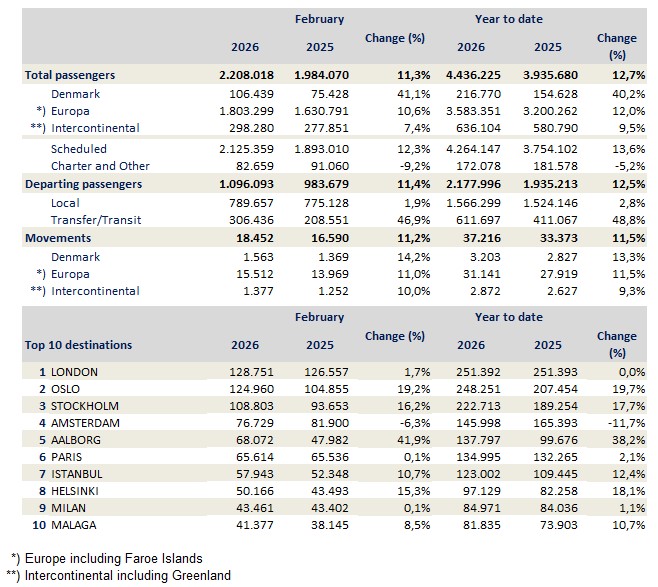
2.2 million passengers passed through Copenhagen Airport in the shortest month of the year. Two winter holiday weeks with high travel volumes, combined with a general increase in transfer passengers, made it the busiest February in the airport’s history. However, unrest in the Middle East has created uncertainty and affected parts of air traffic towards the end of the month.
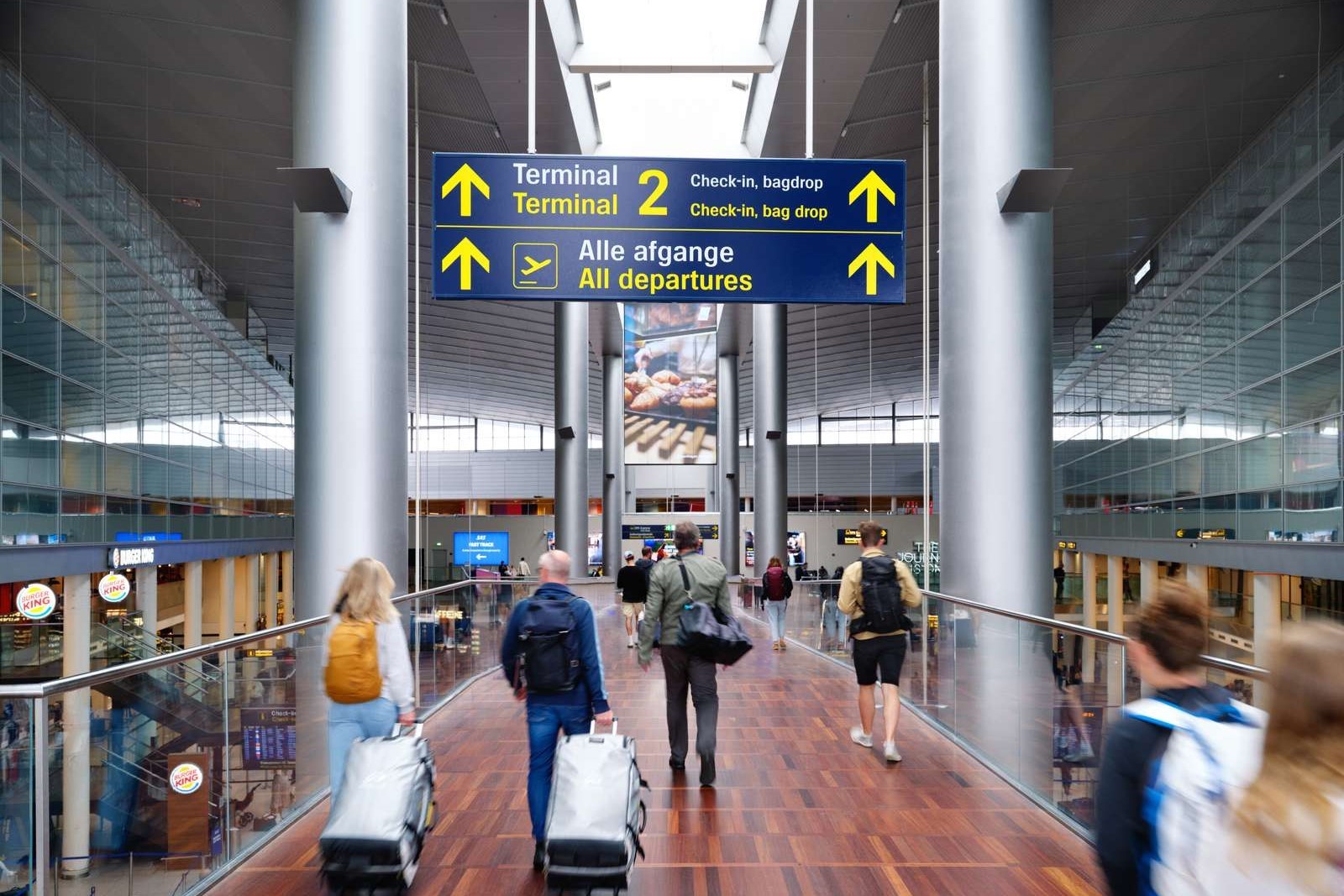
In February, holiday travellers clearly shaped traffic at Copenhagen Airport. A total of 2.2 million passengers passed through the terminals, representing an 11 per cent increase compared with last year.
“We have never previously had so many travellers through the airport in a February. The winter holidays and the cold Danish weather prompted many to seek sun and warmth in Asia or Southern Europe, while others chose the ski slopes of the snow-covered Alps,” says Peter Krogsgaard, Chief Commercial Officer at Copenhagen Airport.
The most popular sun destinations in February were Spain and Thailand, with 190,000 and 42,000 travellers respectively, a combined increase of eight per cent compared with last year. In the Alps, ski destinations in Switzerland, Italy and Austria proved particularly popular, with a combined increase of 17,000 travellers.
Unrest in the Middle East affects air traffic
Since Saturday 28 February, air traffic in the Middle East has been affected by the unrest, which has led to the closure of large parts of the region’s airspace. Over the past four days, this has resulted in 47 cancelled flights between Copenhagen and various destinations in the Middle East.
“So far, around 12,000 travellers to and from Copenhagen have been affected by the situation. We fully understand how frustrating this is for those whose journeys are cancelled, and especially for those stranded abroad who are unable to return home. Safety is our absolute top priority, and it is still unclear how long the airspace over the region will remain closed. We are working closely with the affected airlines at Copenhagen Airport to ensure that flights can resume as soon as the airspace reopens,” says Peter Krogsgaard.
Travellers to and from the Middle East account for three per cent of the total number of passengers at Copenhagen Airport. A large proportion of these travellers transit through the region to continue their journeys to other destinations, for example in Asia.
Copenhagen Airport recommends that passengers stay informed via their airline’s website, app or SMS notifications. Up-to-date information on all departures and arrivals is also available on the airport’s website, cph.dk, or in the CPH Airport app.
More transfer passengers
A significant share of the passenger growth in February is due to an increasing number of transfer passengers. A total of 615,000 travellers were in transit through Copenhagen on a stopover en route to destinations around the world – an increase of as much as 47 per cent compared with last year.
“It is in transfer traffic that we are seeing by far the strongest growth. We can clearly see the results of SAS consolidating more of its operations at Copenhagen Airport, meaning that more than one in four passengers at the airport are now transfer passengers on their way to their final destination,” says Peter Krogsgaard.
The vast majority of transfer passengers are Norwegians, Swedes and Danes who land in Copenhagen to change aircraft and continue on to destinations in North America, the Middle East and Asia. However, there is also a growing number of Americans and travellers from Asia using Copenhagen as a gateway to Europe.
Oslo, Stockholm and Aalborg are the three destinations with the highest number of transfer passengers. In February, 125,000, 109,000 and 68,000 travellers respectively flew between Copenhagen and the three cities, representing a combined increase of 23 per cent compared with last year. Four out of ten passengers on these routes were transfer passengers.
Transfer traffic is important for Denmark
Copenhagen Airport is Northern Europe’s largest transport hub, and transfer traffic is of key importance to Denmark.
“The positive development in transfer traffic makes it possible to attract and develop direct routes that would otherwise not be available from Copenhagen Airport. Without transfer passengers, many routes – particularly long-haul routes – from Copenhagen would simply not be viable,” says Peter Krogsgaard.
Last year, airlines launched 47 new routes, bringing Copenhagen Airport’s total to 367 routes worldwide. With a record number of routes, it has never been easier for Denmark to travel out into the world – or for the world to travel to Denmark.
“The strong air connectivity from Copenhagen benefits the Danish economy. Danish companies gain fast and efficient access to global markets, while international companies and skilled workers choose Denmark as a place to do business and live. Last year, tourism reached new heights, with more visitors benefiting hotels, restaurants and shops, and creating jobs across Denmark,” says Peter Krogsgaard.
Copenhagen Airport expects this positive development to continue, with even more travellers via Copenhagen, a stronger route network and an even greater contribution to the Danish economy.